

Brenna Matendere
Mazowe—Mercury and cyanide contamination along Mazowe River in Mashonaland Central province could be slowly and silently killing thousands of people in a country where food quality regulation and routine health checks are rare.
What begins as a glitter of gold in the muddy waters of the river that runs through a vast expanse of small- and mediu-scale farms ends quietly on Zimbabwean dinner plates, with unpalatable possibilities.
Once viewed only as an environmental crisis affecting riverbanks and aquatic life, gold mining-related pollution along the river has evolved into a far-reaching food safety emergency.
Marks of poison
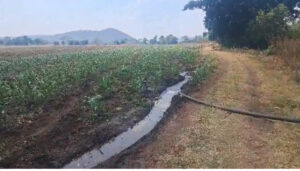
Mercury and cyanide used in illegal and poorly regulated gold mining upstream are seeping into the river, flowing through irrigation canals and accumulating in farmland soils.
In turn, they contaminate crops and enter food markets in greater Harare and beyond, in the process exposing thousands of consumers to toxic substances, experts say.
Field investigations, academic research, market inspections and testimonies as well as government anecdotes show how mercury and cyanide from artisanal and Chinese-linked mining operations contaminate irrigation water, bio-accumulate in crops and move invisibly through Zimbabwe’s food chain.
Official records indicate that Mazowe River rises approximately 40 kilometres north of Harare and flows through fertile agricultural and forest land forming part of a vast catchment basin covering about 39,000 square kilometres in Mashonaland Central and beyond, translating to almost four million hectares.
For more than two decades, the river has sustained farming communities, livestock, and irrigation schemes critical to food production in Mashonaland Central and, farther afield, Mashonaland West.
Along a stretch of the river in Mashonaland Central sit four resettled farms, namely Calgary, Lowdale, Phepford, and St Jerera that have been subdivided into small-scale plots after land reform.

The majority of the plots are A1 farms measuring an average six hectares owned by hundreds of households that received land following the fast track land redistribution programme that commenced in 2000 and continued for several years after.
The area that was investigated with support from Information for Development Trust (IDT), a non-profit media organisation supporting investigative journalism in Zimbabwe and southern Africa, also includes scores of bigger farms measuring beyond 50 hectares.
Together, these farms cover about 1,800 hectares of arable land directly dependent on Mazowe River water.
Calgary Farm spans about 600 hectares and downstream lies Lowdale Farm at roughly 300 hectares, followed by PhepfordFarm (600) and St Jerera Farm (300).
On these farms, smallholder farmers grow maize, wheat, soya beans, potatoes, paprika, green vegetables and green mealies.
At an average yield of two tonnes per hectare, the four farms collectively produce an estimated 3,600 tonnes of agricultural produce per farming quarter each year, which is food destined for domestic and regional consumption mainly in the immediate Mazowe area, Harare, Bindura and Chitungwiza among others.
This produce supplies the Grain Marketing Board (GMB) with maize and feeds informal and formal markets and reaches hundreds of households.
These areas where the produce reaches are populated by more than three million people, meaning that numerous thousands consume the produce on a regular basis.
Mazowe River has increasingly become a processing site for illegal and artisanal gold mining gold.
Our investigations established that illegal gold mining along the Mazowe River is no longer confined to riverbanks.
In several locations, hundreds of illegal miners popularly referred as makorokoza operate directly inside the river channel.
At these sites, mercury and cyanide are used openly in a gold extraction process locally known as sherengete or bhakabhaka.
Ore is washed directly in the river, releasing mercury into flowing water that feeds downstream irrigation systems.
Mercury use is banned under the Minamata Convention on Mercury, an international treaty aimed at protecting human health and the environment.
Zimbabwe domesticated the convention in late 2020 but, despite this, mercury remains readily available to miners.
A 2023 study by IDT, Purses and Curses—Impact of Chinese Mining on Local Communities in Zimbabwe, established that mercury was readily available among stockists despite the ban.
“Mercury contaminates water, accumulates in sediments, and bio-accumulates in fish and tissues of aquatic species,” observed the report.
The report warns that mercury undergoes chemical transformation into methyl-mercury, entering food webs and threatening humans.
During field visits to the farms, the investigation observed artisanal miners digging into riverbeds and adjacent alluvial deposits.
Using shovels and picks, miners load wet sand into 50kg bags, which are then carried to the river’s edge or into the water itself.
Approximately 800 metres from Mazowe River, an area showed clear signs of a recent gold rush.
Excavated pits dotted the landscape while footpaths carved into the soil lead directly to the river where the illegal miners, typically covered in red mud, casually go about their business as modest makeshift diesel-powered ore crushers hum continuously a few metres away.
Groups of artisanal miners crush ore into fine powder before carrying it into the river.
Standing waist-deep in water, they pour mercury into basins of slurry, manually agitating the mixture to bind gold particles.
Grace Madinya, who was washing soil together with her husband, did not deny the risks.
“The riverbed mining is our only source of living. If we get a dollar from gold washing using mercury, even though it is banned and harmful to us, we have no other choice,” she said.
She said mercury was bought in Harare despite its illegality, underscoring the existence of an informal but reliable supply chain.
Downstream from mining sites, the river water is visibly muddy.
In some sections, water flow has been partially diverted or drained by excavation, exposing riverbeds and altering natural hydrology.
Cyanide and Chinese-linked mining
Alongside artisanal miners, Chinese-owned and subcontracted mining companies operate gold claims near the river using cyanide for ore processing.
Unlike mercury, which is typically used by small-scale miners, cyanide is employed in more industrial extraction methods.
However, its disposal presents equally serious risks.
Investigations found multiple instances where slime dumps—the residue of cyanide processing—were placed dangerously close to the river, in some cases within 15 to 20 metres.
At Lowdale, Alpes Mine subcontracted Chinese operators to mine gold on a claim located approximately 50 metres from Mazowe River.
Slime dumps were positioned downslope from the mine, separated from the river only by a perimetre fence.
During rainfall, gravity and runoff carry cyanide-laced waste directly into the river.
Direct observations revealed no lined containment facilities or effective barriers to prevent seepage.
The risk is compounded during the rainy season, when floodwaters spread impurities over a wider area and into irrigation channels.
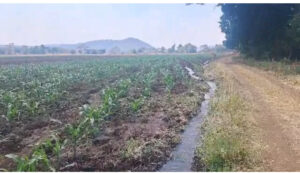
For farmers along Mazowe River, irrigation is not optional; it is essential for survival.
Small-scale farmers irrigate at least twice a week using canal systems that divert water from the river.
Water is shared through a rotation system through the flooding system, with farmers often irrigating at night when flow levels are highest.
The farmers have set up ad hoc teams to regulate the distribution of the water to ensure every user gets some water for crops.
However, during the winter wheat period dominated by the larger farms, the small plots holders get minimal supplies.
Other farmers use suction pumps to draw water directly from the river, irrigating four days a week during hot spells to prevent crop failure.
Each irrigation cycle transfers contaminated river water onto farmland, where mercury adheres strongly to soil particles and organic matter.
Unlike pesticides that degrade over time, mercury persists in soils for decades. Once absorbed by plants, it cannot be removed through washing, cooking or processing.
What research reveals
Scientific research strongly indicates that gold mining near or along Mazowe River is contaminating the water source with mercury and other harmful pollutants.
A 2017 thesis authored by a scholar, Vimbai Chandiwana, and published by the University of Zimbabwe—Assessment of the Impacts of Artisanal Small-scale Gold Mining on Environmental Governance within the Mazowe catchment,” confirms serious contamination of the river
“Mercury was present from effluent sampled from the artisanal mining sites, indicating that mercury is used as an extracting gold agent by artisanal miners in situ,” says the study.
The research further notes: “If the Mazowe River is polluted with the (mercury-laden) effluent, it cannot be used for domestic purposes”.
More recently in 2024, a University of the Witwatersrand thesis titled “Heavy metal contamination and its spatial distribution from mining wastes in receiving environments of Mazowe District, Zimbabwe”sampled sediments and water at five sites up to 25 kilometres downstream.
The study detected mercury, lead, chromium, and cadmium in river sediments, with lead levels reaching approximately 26.68 mg/kg, which is considered to be hazardous.
While water samples showed “low detectable” heavy metal levels, sediment contamination signals long-term accumulation.
A 2018 peer-reviewed study using erosion and hydrology modelling found high sediment delivery rates, increased turbidity, and degradation of water quality across the Mazowe catchment.
The food chain
The contaminated crops grown along Mazowe River do not remain local.
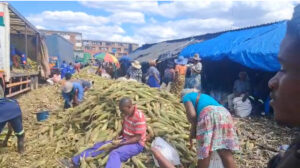
At Mbare Musika, Zimbabwe’s largest wholesale agricultural market, investigators tracked produce from the four Mazowe farms as it entered national circulation.
Between 8am and 3pm on a single observation day, 12 trucks loaded with green mealies from the Mazowe farms were offloaded.
Each truck carried an estimated 1,500 cobs.
Traders confirmed that such volumes were common at the end of each farming quarter.
“All the cobs are bought because of demand,” said trader Nomore Nhari.
“People resell them in Chitungwiza, Mvurwi, Norton, Shamva, Marondera.”
Produce buyers from different parts of Harare that include Mbare, Mabvuku-Tafara, Chitungwiza, Epworth, Kuwadzana and Budiriro do not always passively wait for deliveries from the farmers, Instead, using small trucks, they scout the Mazowe area and sometimes buy whole fields and ferry the produce to their respective destinations, indicating high demand for the crops from the area.
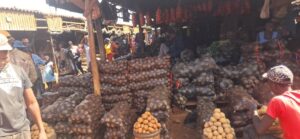
Walk-in customers from across the capital and nearby areas like Glendale and Bindura also buy potatoes and vegetables sourced from Mazowe farms for domestic consumption.
Eight additional 32-tonne trucks delivered tomatoes, potatoes, and leafy vegetables from the same farms when our news crew visited the popular and relatively cheap Mbare Musika.
Traders who were interviewed at the market said there were no routine tests to check for mercury, cyanide or heavy metals.
Food chain and human health
Dr Nyasha Sakadzo, an agriculture lecturer at Manicaland State University of Applied Sciences with research interests in plant protection, warned that mercury contamination represents a chronic and largely invisible health risk.
“Mercury is remarkably persistent.
When farmers use contaminated water for irrigation, it accumulates in soils and is taken up by crops—leafy greens, grains, root vegetables—without any visible warning signs,” he told this publication.
He said mercury could transform into methylmercury, which bioaccumulates within plant tissues.
“Continuous consumption of crops cultivated under these conditions (mercury-polluted water) leads to a gradual, chronic accumulation of mercury in individuals.
Scientific research indicates that prolonged ingestion can impair neurological function, disrupt cognitive development in children, weaken immune system and result in kidney and cardiovascular issues,”he noted.
Pregnant women and infants face heightened risks because mercury crosses the placenta, he added.
Cyanide, while less persistent, poses acute dangers at high concentrations, said the scholar.
University of Zimbabwe food safety expert, Batsirayi Chipurura,corroborated these findings, warning of long-term toxic exposure through food.
In October, EMA and Zimbabwe National Water Authority (ZINWA) inspections found Chinese companies JiayunInvestment and Ying Can Pvt Ltd polluting the Mazowe River through alluvial mining.
The firms were fined and ordered to vacate riverbeds in Uzumba-Maramba-Pfungwe wards 6 and 7 in the same province.
Information ministry permanent secretary, Nick Mangwana,confirmed: “Four companies, including some owned by foreigners, have been stopped from operating at the site.”
However, artisanal miners quickly occupied abandoned areas at night, continuing illegal operations.
The EMA spokesperson, Amkela Sidange, said the issue of river water pollution went beyond her organisation and urged a “whole-of-government approach.”
GMB declined to confirm whether testing is conducted and farmers lack capacity while consumers remain unaware.
Farmers’ representatives are concerned about the high probability of food poisoning through mercury and other metals and bemoan the lack of food quality testing mechanisms.
Paul Zachariya, the Zimbabwe Farmers Union (ZFU) executive director, said the mostly small-scale farmers lacked the resources to test both their produce and the river water, adding that water pollution by the miners was discussed at their 2024 congress.
“There is a lot of illegal mining across the country. At our congress last year, this issue was raised by farmers and we are working to find a solution to the problem through mutual engagement,” he said.
“We have not made arrangements for testing for chemicals from mining activities but acknowledge the potential of the risk of poisoning.
“If the situation continues like that, in the next five years there will be serious effects on farms,” he added.
Horticulture Development Council, which connects farmers with new markets and investment opportunities admits they do not have a set procedure of testing agricultural produce.
“We don’t have any assessments (of produce) as yet,” said the association’s founding chief executive officer, Linda Nielsen.
Professor Obert Jiri, the permanent secretary for the ministry of Lands, Agriculture, Fisheries, Water and Rural Development declined to comment and referred questions to GMB, which did not respond to questions.